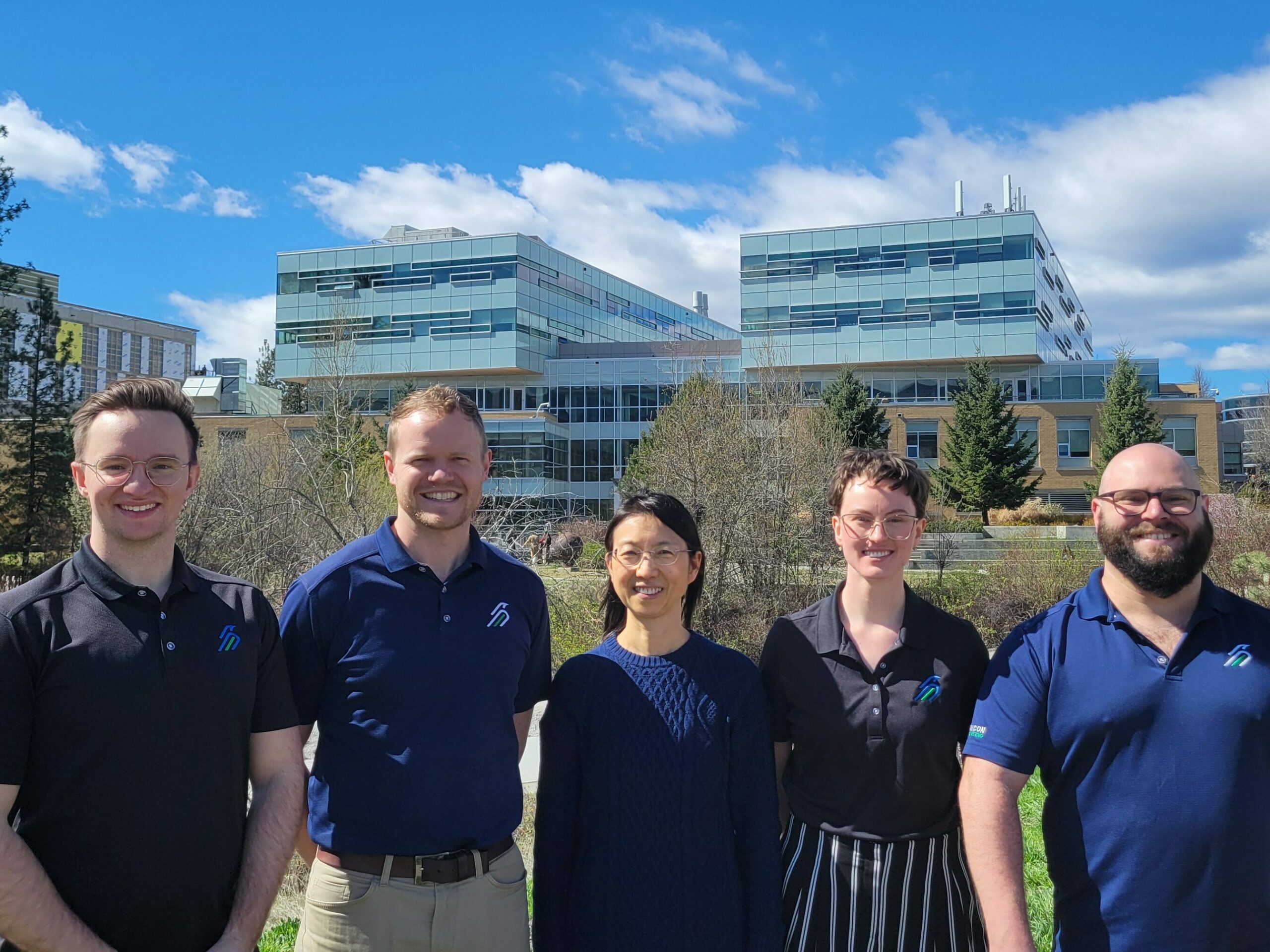
Recently, a group of Falcon’s Engineers in Training (Abby Stokes, Cole Baun, Colin Forsyth, and Isaac Alexander), accompanied by Falcon Principal Jeff Quibell, P.Eng., were given the incredible opportunity to contribute to a guest lecture on HVAC design for Dr. Claire Yan’s ENGR598A class (comprised of UBCO Master of Engineering Students) at the University of British Columbia in Kelowna, BC.
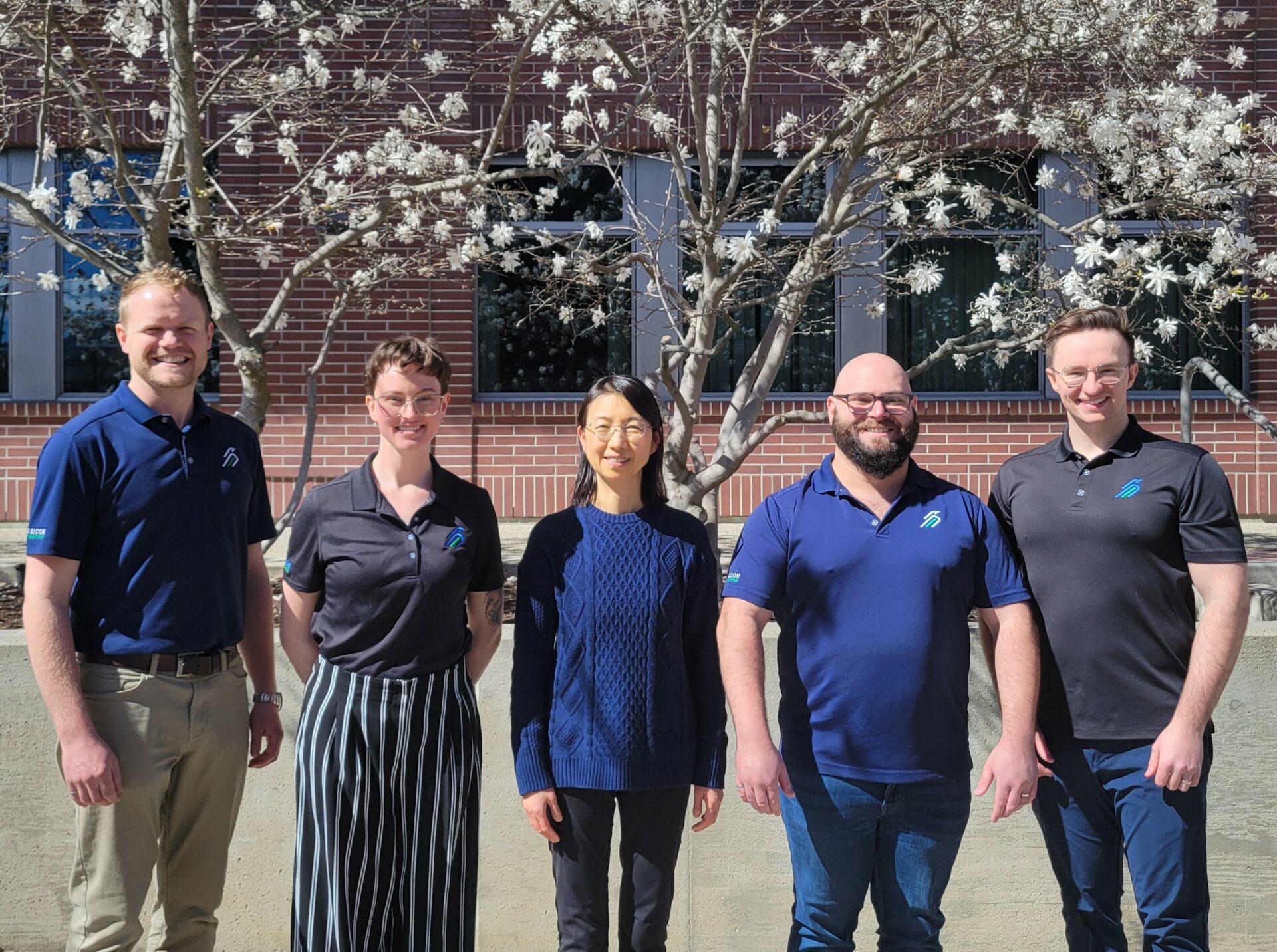
When the opportunity was first discussed near the end of 2025, Dr. Yan indicated that her students would be completing the 2026 ASHRAE design competition for their course project. This year’s ASHRAE design competition involves designing a HVAC system for a new educational facility to be built at a fictional university in Denver, Colorado. As master’s students, Dr. Yan’s students were not eligible to actually compete because the competition is reserved strictly for undergraduates. Nevertheless, the design challenge remained an excellent chance for Dr. Yan’s students to develop their Heating, Ventilation, & Air Conditioning (HVAC) design skills.
The Falcon Team developed their presentation with the objective of assisting Dr. Yan’s students in their course project. Jeff worked with Dr. Yan to create the opportunity and Abby, Colin, Cole, and Isaac prepared and delivered the presentation. The presentation team received support from Jeff and content feedback from Falcon Principal’s Hayley Shearer, P.Geo., M.Eng., CEM and Andrew Stringer, P.Eng. during the months leading up to the guest lecture.
Approaching HVAC Design
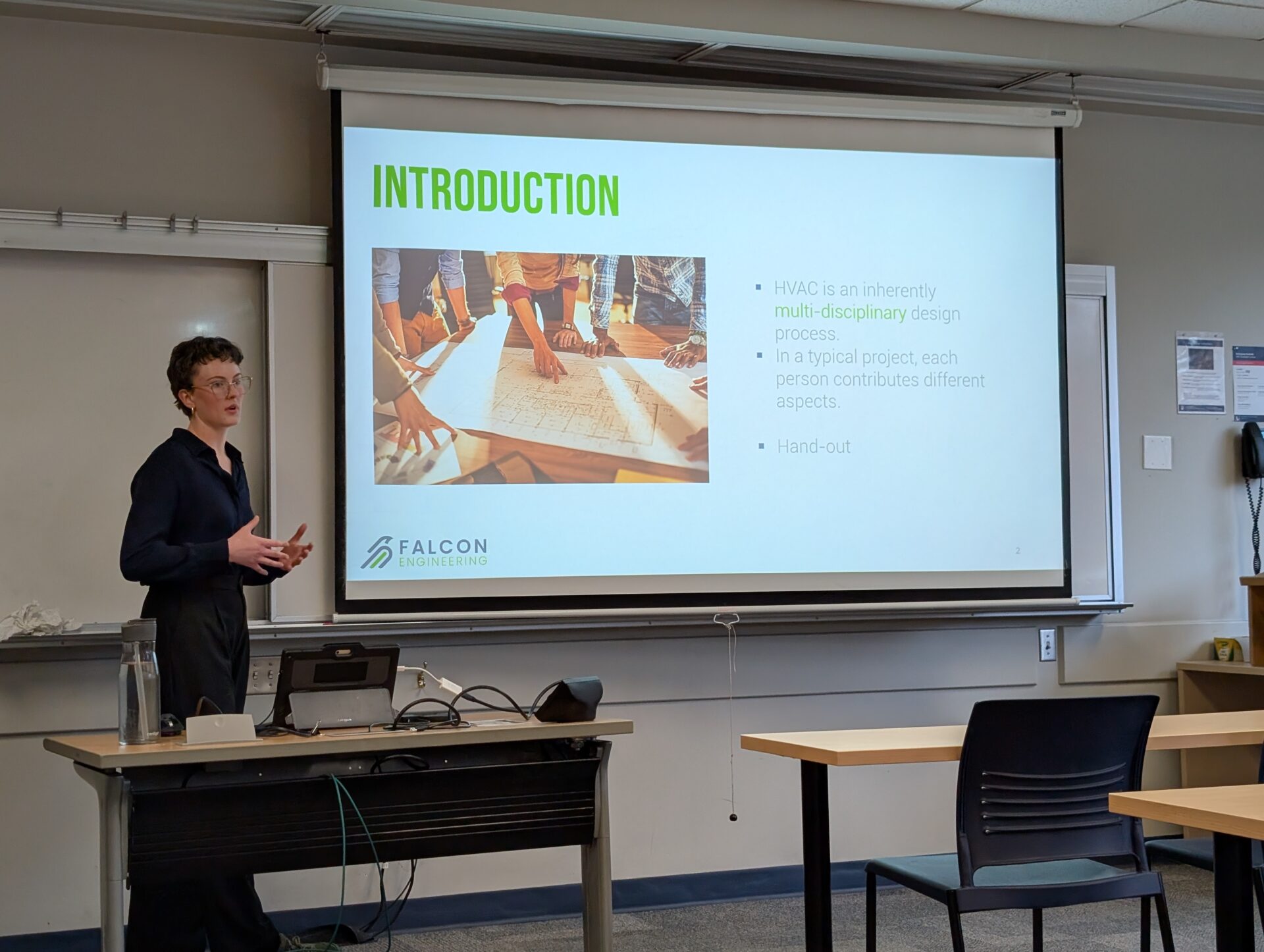
HVAC design can be complicated and overwhelming, but the Falcon team hoped that this HVAC design guest lecture, with some of their support and insight, would allow Dr. Yan’s students to be able to enjoy the design challenge and develop practical skills and understanding that they could carry forward with them into their careers.
Two of the key components of the design competition that the students needed to provide in their course project were HVAC system selection and HVAC design calculations.
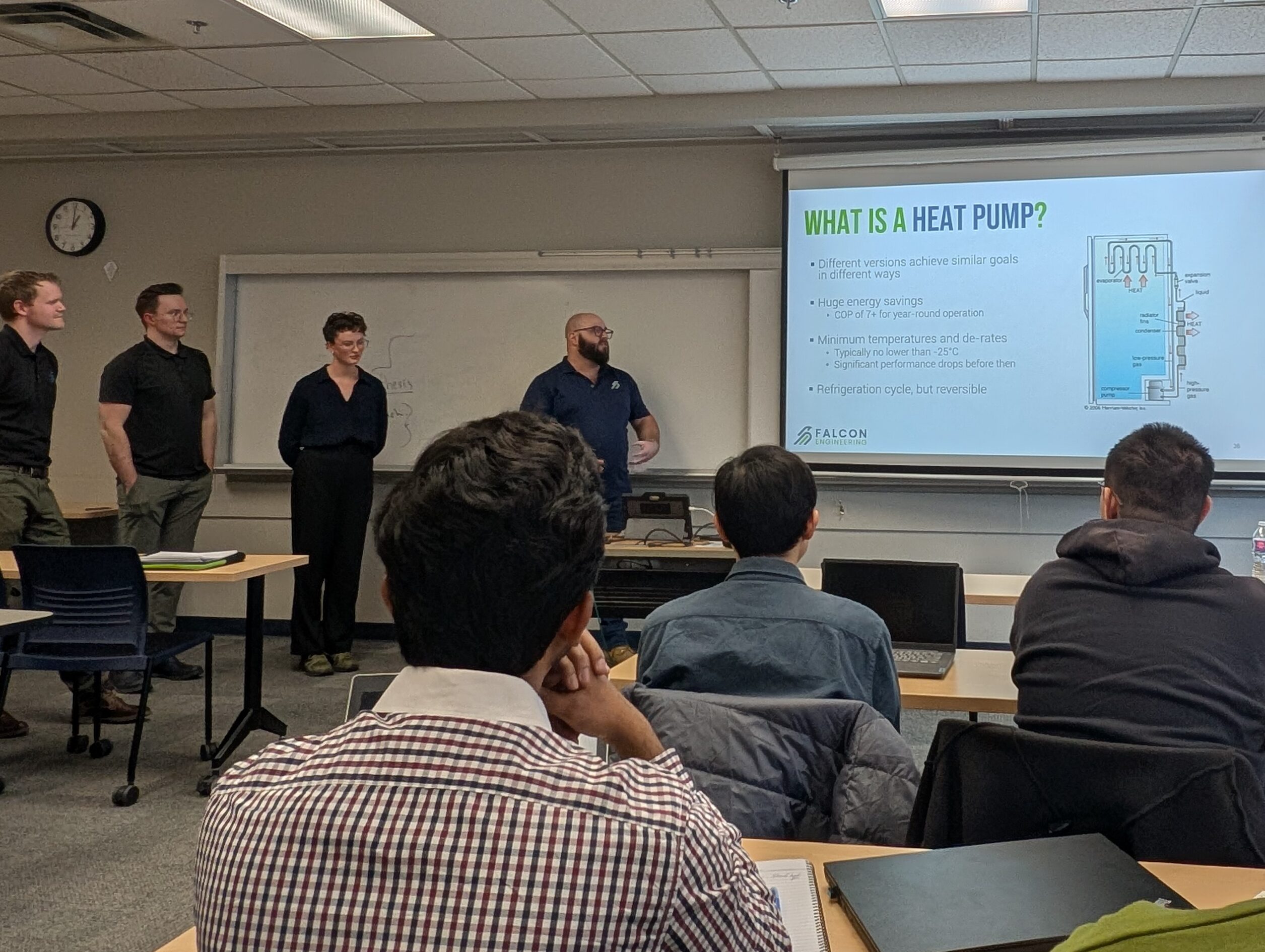
Two members from Falcon’s Mechanical Design team, Abby Stokes, EIT, and Colin Forsyth, EIT, began the presentation by contributing their perspectives as mechanical design EITs. They helped lay the groundwork for understanding HVAC system selection and introduced the HVAC design industry by:
- Describing typical project steps and progression
- Sharing typical project objectives and modes
- Outlining roles and responsibilities of different key players
- Highlighting tools of a typical HVAC designer
Abby and Colin encouraged the students to use heat pumps to improve sustainability and reduce energy usage. They also contributed helpful tools and resources that would assist students in their course project, including Falcon’s ‘HVAC Designer Cheat Sheet’. Abby, with help from the rest of the team, was instrumental in helping to develop the ‘HVAC Designer Cheat Sheet’ which included Falcon’s ‘Poole’s Rules’ – design rules developed by Don Poole, P.Eng., a retired Falcon Principal who was the first Falcon staff member to present to Dr. Yan’s class over 6 years ago.
The Role of Energy Modelling in HVAC Design
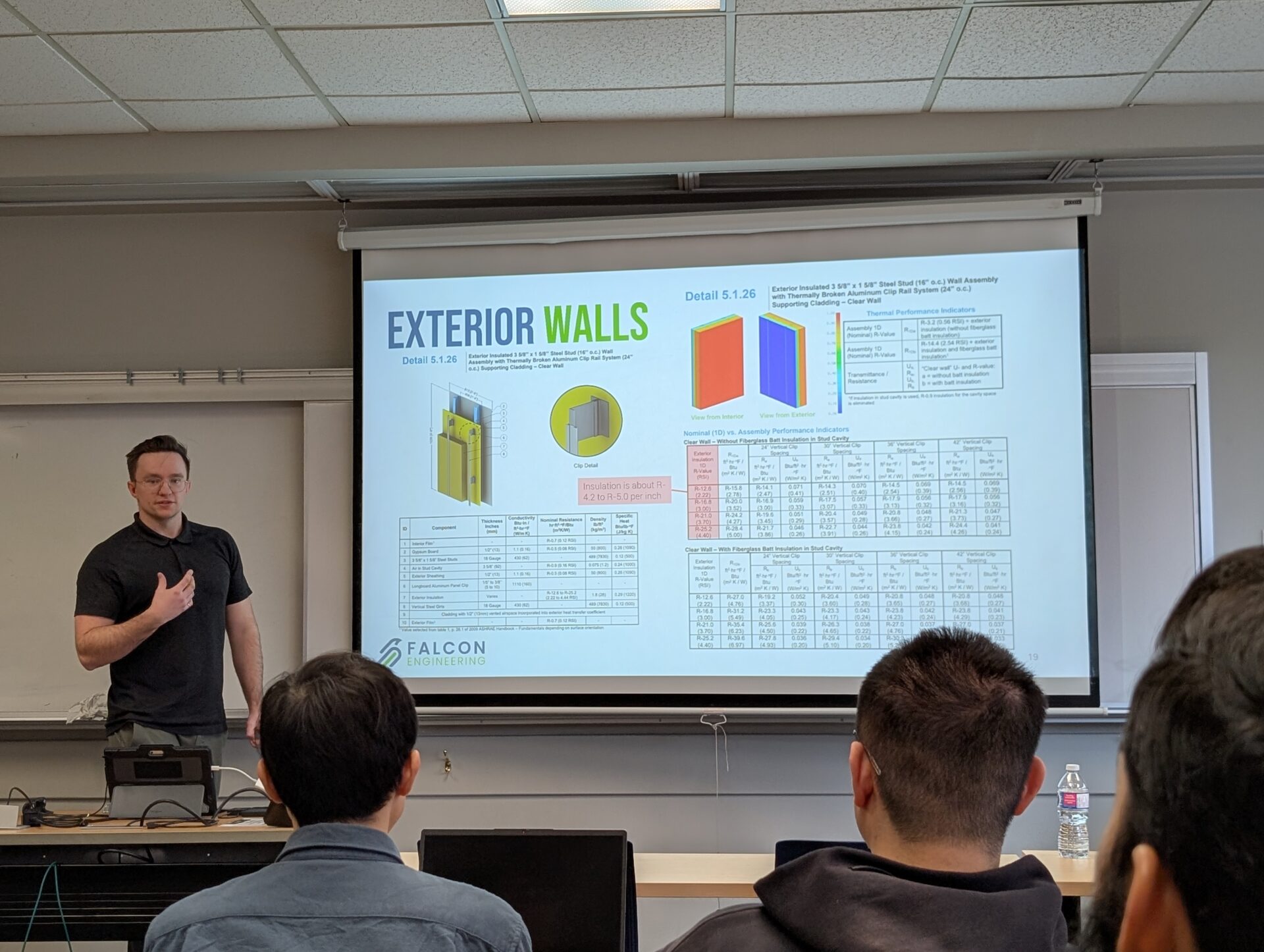
Next up was Cole Baun, EIT, who contributed his expertise as an Energy Modeller. He detailed the critical inputs needed to perform HVAC design calculations, which was a key deliverable for Dr. Yan’s students in their course project.
Cole included some example design calculations and explained why energy modelling was relevant to their course project. He also shared some context of energy modelling in BC and the different building codes that the project would be required to satisfy if it were developed in a BC setting.
Abby and Colin joined Cole to share some real-world industry experience regarding how energy modellers and mechanical designers collaborate in a typical project. They highlighted key design junctures and the role that each team plays in reaching them (e.g. HVAC equipment sizing and selection).
Point of Interest – Geoexchange
Though not relevant to the student’s course project, Isaac Alexander, EIT, concluded the presentation with a brief overview of geoexchange systems. ASHRAE specifically barred the use of geoexchange technology in this competition. However, given the rise of sustainability-driven engineering solutions in the industry today, the Falcon team agreed it that remained relevant to share some of the current innovative uses of geoexchange technology with the students.
Isaac also presented examples of pioneering in the HVAC industry, highlighting example projects that reflect a shifting mentality toward energy conservation, sustainability, and reducing reliance on non-renewable resources. Several unique aspects of working on some of Falcon’s geoexchange pioneering projects were highlighted, like the Vancouver Island University District Energy System in Nanaimo, BC (Check out our brief project overview here).
The Importance of Connection Opportunities Between Students and Engineers
The opportunity to provide this HVAC design guest lecture at UBCO for Dr. Claire Yan’s ENGR598A class proved to be enriching for both Falcon’s EIT’s and the UBCO students. This collaborative opportunity highlights the immense value that connection between industry professionals and engineering students can bring to all parties involved.
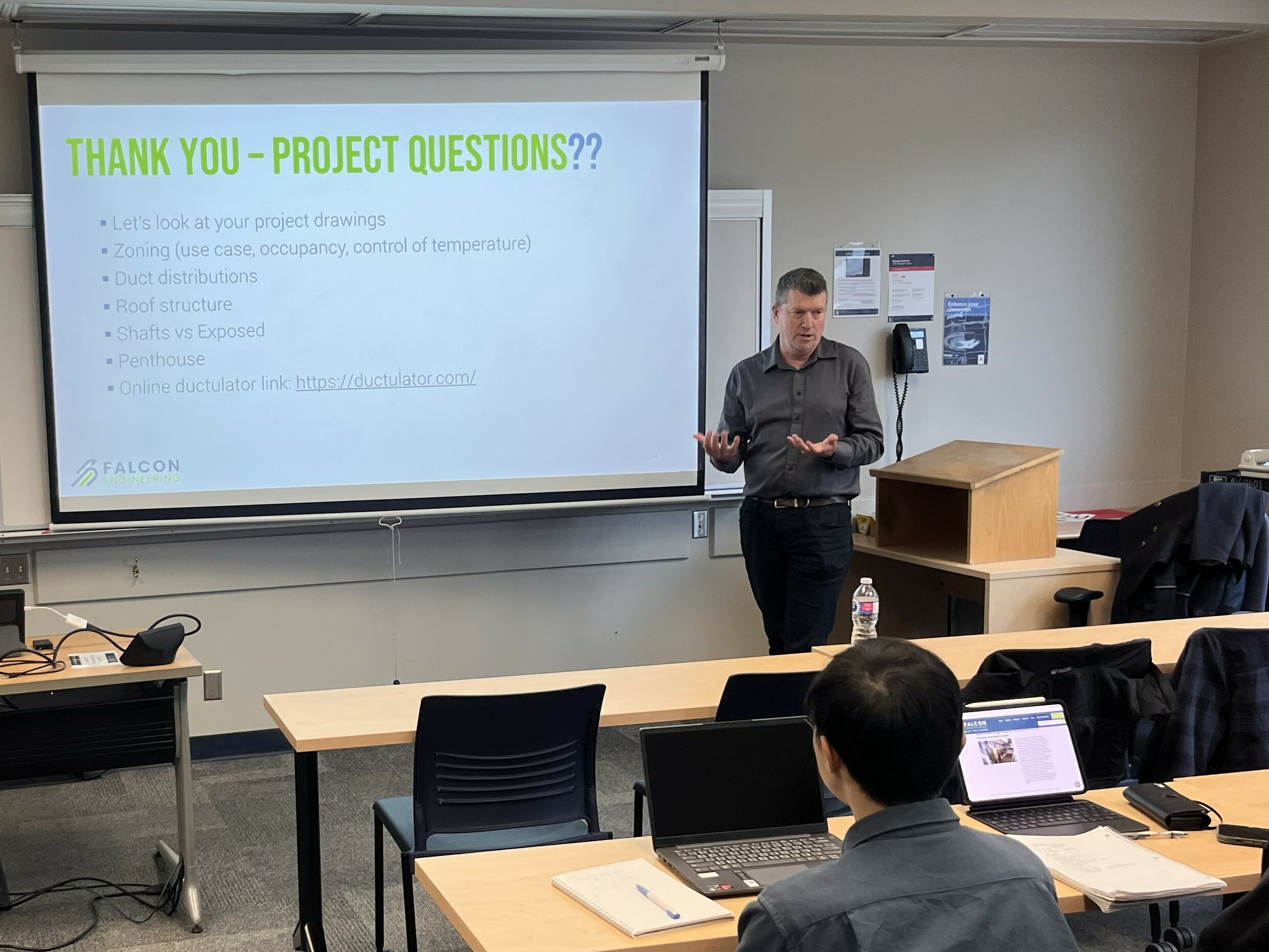
For the engineering students, hearing directly from professionals within the industry gave them a window into real-world engineering challenges, current industry practices, and emerging technologies. It also gave the students the opportunity to ask questions, receive guidance, and begin forming professional relationships that may support future co-op placements or employment opportunities.
Interactions like these are known to help bridge the gap between academic learning and professional application for engineering students preparing to enter the workforce. By incorporating interesting technical presentations into the engineering curricula, Dr. Yan provides her students with the incentive to evolve their own communication style and approach, setting them up for success in whichever engineering discipline they choose to pursue.
For professional engineers and EIT’s, presentation opportunities with both peers and students provide a variety of benefits. In today’s rapidly evolving engineering landscape, both communication and technical expertise are essential skillsets. Engineers do not only need to understand complex technical concepts, but they must also be able to explain them clearly, confidently, and professionally. Presenting gave Falcon’s EIT’s the chance to continue to hone their communication skills. In addition, Abby, Colin, Cole, and Isaac got to network with colleagues in academia and work on the core competencies required for them to one day become licensed engineers.
Connection opportunities like these also give professional engineers and EIT’s the chance to ‘give back’ by contributing to a richer, more practical educational experience for their future peers. The result is more well-rounded engineers who are not only technically strong but also prepared to collaborate, communicate, and contribute meaningfully in the workplace, strengthening the industry as a whole.
Falcon is incredibly grateful to Dr. Yan for continuing to create these amazing opportunities for her students, and for allowing Falcon to collaborate. Thank you Dr. Yan!
Want to learn more about our services?
You can find out more about our services here and more about our team here.
Or, contact us by using our contact page here.
Want to learn more about our projects?
Visit our projects page here.
Or, check out some of our other blog posts!