What is Exploratory borehole drilling?
Exploratory borehole drilling is an exciting step in the process of many Geoexchange Suitability Assessments (GSAs). GSAs are multi-step programs that evaluate the suitability of geoexchange systems at a particular site. They involve evaluating site-specific conditions to determine available site-specific option for geoexchange solutions. If the results from exploratory borehole drilling look promising, the process of designing and implementing a full scale geoexchange heating and cooling system can accelerate!
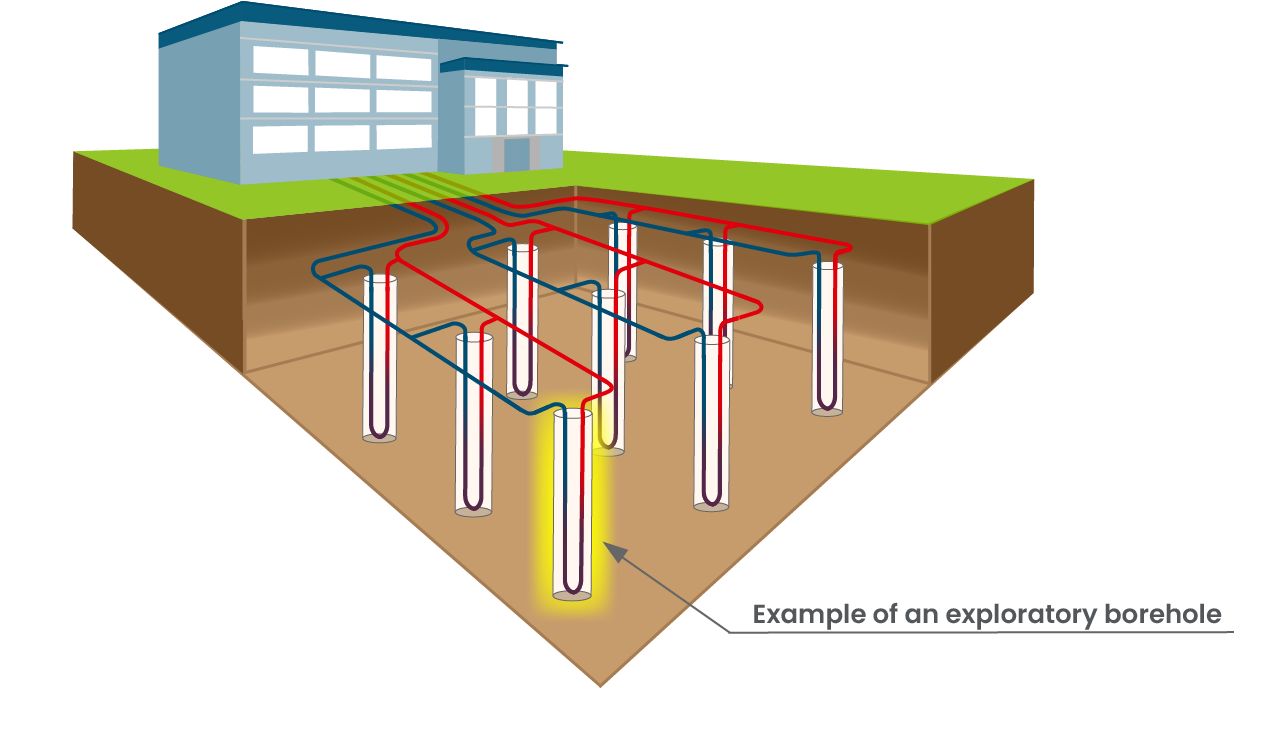
On the topic of geoexchange systems, there are a few different ways in which geoexchange systems can exchange heat with the ground to heat and cool buildings. In the video below, the crew from Ground Source Drilling Ltd. are drilling a 90m deep Closed-Loop Vertical Borehole that will one day belong to a built-out Ground Heat Exchanger (GHX).
Once a network of interconnected boreholes (also known as GHX) is completed, heat transfer fluid will be circulated through the boreholes. When a finished building is connected, these pipes will allow the building to be cooled in the summer by transferring and storing the building’s heat into the ground. In the winter, this system will return to the heat stored in the ground and recover it to warm the building.
Geoexchange systems achieve high efficiencies year-round thanks to the ground’s moderate temperature. Higher efficiency means every unit of electricity purchased will be leveraged to greater effect: carbon emission will be reduced and utility costs to heat and cool the building will drop.
Now, lets take a deeper look at how exploratory borehole drilling contributes to successful geoexchange projects!
Exploratory borehole drilling: An exciting step in Geoexchange Suitability Assessments
Exploratory borehole drilling is an intriguing part of many GSAs. The team at Falcon Engineering gets excited whenever a GSA advances to the exploratory borehole drilling phase! Moving to this stage reflects confidence in the site’s unique suitability for geoexchange technology, stemming from the research and results of earlier stages of analysis.
In a structured GSA approach (as refined by Falcon’s own Jeff Quibell, P.Eng.), a project will proceed to exploratory drilling only after a high probability of success for geoexchange is established at the site. Exploratory drilling represents an investment from the client and their investment is leveraged in two key ways:
1. Evaluation of ground thermal properties
Upon the completion of drilling an exploratory borehole, location-specific ground thermal properties can be evaluated, such as ground thermal conductivity – the ground’s ability to transmit heat – and the passive ground temperatures along the length of the borehole. These properties significantly effect the performance of a geoexchange system, so measuring them before a design is finalized enables the design team to fine-tune geoexchange field sizing. This helps ensure that the client will only buy as much installed Ground Heat Exchanger (GHX) capacity as is required to right-size the system.
2. Construction cost management through mitigation of contractor risk
Exploratory boreholes provide site-specific information about drilling conditions to prospective contractors that was previously unavailable. This significantly reduces the risks for contractors who might be interested in working on the project. In fact, it is common for the contractor who drills the exploratory boreholes to submit a bid for the project when the complete GHX construction package goes to Tender.
By documenting and sharing a description of conditions encountered below ground and the rate of drill progress observed during the drilling of exploratory boreholes, Falcon’s design team provides valuable, pertinent information to contractors during the bidding process. This has proven to be an effective method to mitigate contractor risk. With less risk, contractors often choose to bid the work more aggressively, resulting in savings for the client.
Incorporating exploratory boreholes into the final GHX system
On top of leveraging every dollar spent on exploratory borehole drilling in the above ways, Falcon’s design team also makes every effort to incorporate the exploratory boreholes into their design of the final GHX. When an exploratory borehole is incorporated into the final GHX, it displaces one borehole required by the completed system. This is the quiet power of carefully prescribed exploratory borehole drilling – when an exploratory borehole is successfully integrated into a final GHX, its net effect is an almost negligible increase in effort and cost within the construction of the completed GHX.
Despite this low cost, exploratory boreholes offer powerful insights into site specific conditions at a critical project stage, allowing designers to tailor the designed system capacity to suit while also helping to reduce construction costs through mitigation of contractor risk.
All that benefit for minimal additional cost and effort? Now, that’s savings!
Contact us today to discuss your project!
Want to learn more about Geoexchange?
Check out our blog: https://falcon.ca/tag/geoexchange and our project profiles: https://falcon.ca/project_tag/geoexchange